










 Call
Call 


 Access Your Account
 Where Americans Search for “Internet Outage” the Most: 2026 Study

Table of Contents
CompareInternet analyzed a year of search data to identify where internet outage searches are highest and lowest across the U.S., which internet providers generate the most outage-related search interest, and what drives Americans to shop for new internet service.
When the internet suddenly stops working, many people have the same first reaction: search for an outage to see whether anyone else is having the same problem.
How often that happens varies widely depending on where you live.
CompareInternet analyzed a year of Google Trends data to see where “internet outage” has the highest relative search interest across the U.S. We then compared outage-related searches for eight major internet providers to see which providers generate the most search interest nationwide and which one leads in each state.
One state stands clearly above the rest. Alaska records the highest relative search interest for “internet outage,” with a score of 100, 12 points ahead of Wyoming.
The provider results have a clear leader too. Spectrum records the highest nationwide search interest for “internet outage” among the eight providers analyzed, with a score of 52, exactly twice Xfinity’s 26.
And a separate analysis of 171,003 internet-shopping calls reveals a different side of the story. When people start shopping for a new connection, outages are far from the most common reason. Moving is.
Key Takeaways
- Alaska has the highest relative search interest for “internet outage” in the U.S. It scores 100 on Google Trends, putting it 12 points ahead of second-place Wyoming at 88.
- The South is heavily represented among the states searching for internet outages the most. Five of the top 10 states are in the region: West Virginia, North Carolina, Oklahoma, Tennessee and South Carolina.
- The Northeast dominates the opposite end of the ranking. Six of the 10 states with the lowest search interest are in the Northeast, with New Jersey recording the lowest score in the country at 36.
- Spectrum has the highest nationwide search interest for internet outages among the eight providers analyzed. Its Google Trends score of 52 is exactly twice Xfinity’s 26. Verizon ranks third at 20, followed by Cox at 16, AT&T at 15, and Frontier at 12, while CenturyLink and T-Mobile are tied at 2.
- T-Mobile doesn’t lead outage-related searches in a single state. While Spectrum, Xfinity, Verizon, and Cox each lead across multiple parts of the country, even Frontier and CenturyLink take the top spot in at least one state. T-Mobile is the only provider analyzed that never ranks No. 1 in any state.
- Moving stands far above every other shopping reason in CompareInternet’s call data. Of the 85,080 calls where a primary reason could be identified, 41,637, or 48.9%, were related to moving, making it nearly four times as common as fiber availability, the next-largest category.
- Despite the attention outages generate online, reliability is a much smaller factor when consumers actually shop for internet service. Outages and reliability accounted for just 7% of classified shopping calls, behind moving (48.9%), fiber availability (12.4%), data caps (12.1%) and price (10.5%).
Alaska Leads Every State for “Internet Outage” Search Interest
Google Trends measures relative search interest on a scale from 0 to 100. A score of 100 represents the location where a search term has the highest relative popularity during the period studied, with other locations scored against that benchmark.
For “internet outage,” Alaska sets the benchmark.
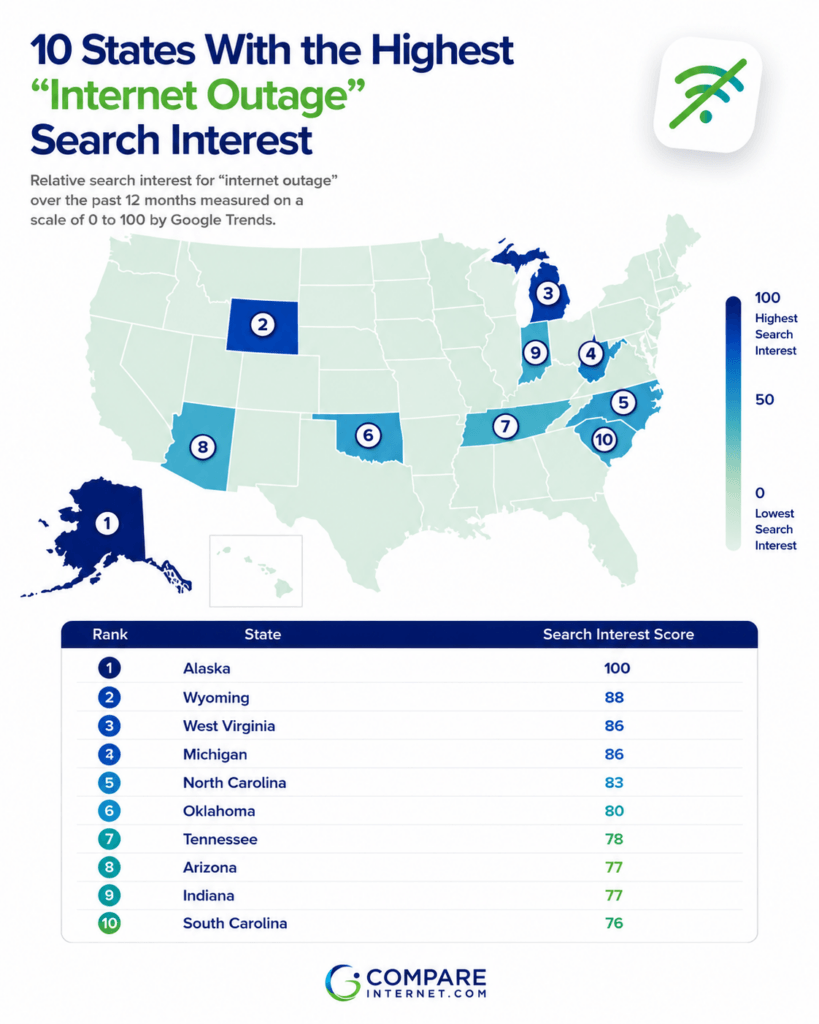
Alaska stands out with a score of 100, 12 points ahead of Wyoming at 88. The gap narrows quickly from there, with West Virginia and Michigan tied at 86, followed by North Carolina at 83 and Oklahoma at 80.
A clear regional pattern also emerges near the top of the ranking. Five of the 10 states with the highest search interest are in the South: West Virginia, North Carolina, Oklahoma, Tennessee, and South Carolina.
Population alone doesn’t explain the results. Alaska and Wyoming, two of the least populous states in the country, occupy the top two spots, while several much more populous states rank considerably lower.
That’s because Google Trends reflects relative search interest within each state, rather than the total number of searches or the number of internet outages that actually occurred.
Six of the 10 States With the Lowest Search Interest Are in the Northeast
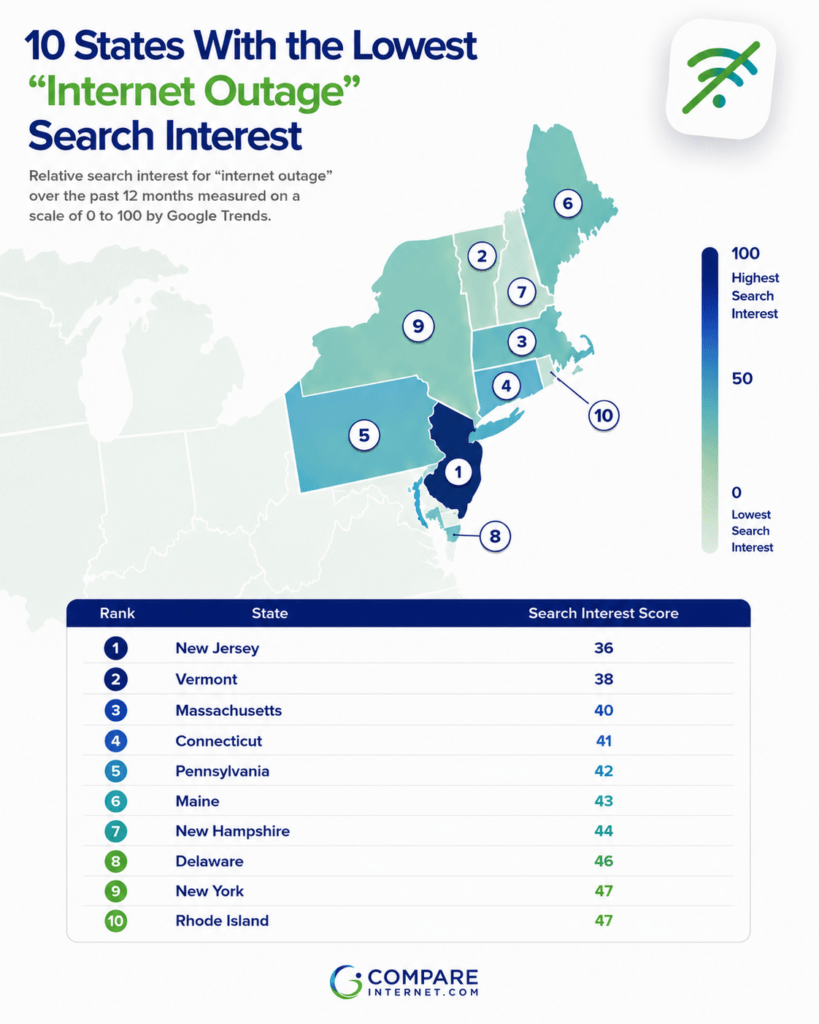
The other end of the ranking shows a very different geographic pattern.
Six of the 10 states with the lowest relative search interest for “internet outage” are in the Northeast: New Jersey, Vermont, Massachusetts, Connecticut, New York and Rhode Island.
New Jersey records the lowest score in the study at 36, while the Northeast as a whole averages approximately 47, roughly 20 points below the other regions in the analysis.
The contrast is particularly interesting when compared with the top of the ranking. Alaska and Wyoming, two sparsely populated states, take the first two spots, while New Jersey, one of the most densely populated states in the country, sits at the bottom.
A lower score, however, should not be read as evidence that a state has fewer outages or more reliable internet. It simply means “internet outage” had lower relative search interest there during the period studied.
Spectrum Has the Highest Nationwide Search Interest for Internet Outages
Among the eight major internet providers analyzed, Spectrum has the highest nationwide search interest for internet outages. Its average Google Trends score of 52 is exactly twice Xfinity’s 26.
Verizon ranks third at 20, followed by Cox at 16, AT&T at 15, and Frontier at 12. CenturyLink and T-Mobile sit at the bottom of the nationwide ranking, tied at 2.
Internet Provider Outage Search Interest Nationwide
| Rank | Provider | Search Interest Score |
|---|---|---|
| 1 | Spectrum | 52 |
| 2 | Xfinity | 26 |
| 3 | Verizon | 20 |
| 4 | Cox | 16 |
| 5 | AT&T | 15 |
| 6 | Frontier | 12 |
| 7 (tie) | CenturyLink | 2 |
| 7 (tie) | T-Mobile | 2 |
The gap at the top is substantial. Spectrum’s nationwide score is twice Xfinity’s and more than two and a half times Verizon’s.
These results do not mean Spectrum experiences more outages than the other providers. Google Trends measures relative search interest, not network reliability or the number of outages. Provider size, geographic coverage, and individual outage events can all influence search activity.
The nationwide ranking also hides significant differences from one state to another. Looking at which provider generates the most outage-related search interest in each state reveals a much more fragmented picture.
T-Mobile Doesn’t Lead Outage-Related Searches in a Single State
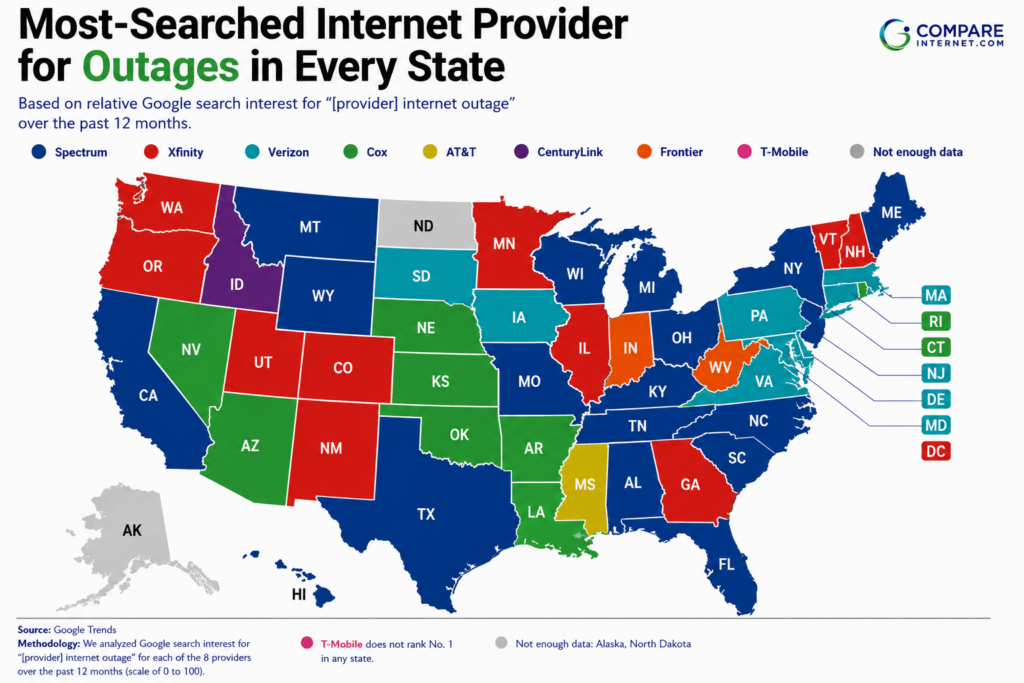
The state-by-state results show that no single provider dominates in all states.
T-Mobile is the exception. Despite being one of the eight major providers included in the analysis, it does not rank No. 1 for outage-related search interest in a single state.
The Most-Searched Provider for Outages Varies Widely by State
The state-level results reveal a much more fragmented picture than the nationwide ranking.
Spectrum leads outage-related search interest in many states, including Maine, Montana, Wyoming, Kentucky, Wisconsin, North Carolina, Ohio, Missouri, South Carolina, Tennessee, New York, Michigan, California, Texas, Indiana, Alabama, and Florida.
But the pattern changes considerably in other parts of the country. Xfinity ranks first in Washington, Oregon, New Hampshire, Minnesota, Georgia, Colorado, Illinois, New Mexico, Utah, and Vermont. Verizon leads in Massachusetts, Pennsylvania, Virginia, New Jersey, Maryland, Delaware, Iowa and South Dakota.
Cox also has several states where it generates the highest outage-related search interest, including Nebraska, Nevada, Kansas, Connecticut, Louisiana, Arizona, Oklahoma, Arkansas and Rhode Island.
Some providers have much more concentrated pockets of search interest. Frontier leads only in West Virginia, while CenturyLink leads in Idaho. AT&T leads in Mississippi.
Alaska and North Dakota were excluded from the state-level provider comparison because there was not enough search data to make a reliable comparison across all eight providers.
Some State Races Are Extremely Close
Not every state has a clear runaway leader.
Kansas has one of the closest results in the study. Cox records a search interest score of 37, narrowly edging AT&T at 35. Connecticut is similarly close, with Cox at 28 and Xfinity at 27.
Oregon also comes down to a two-point difference, with Xfinity scoring 41 compared with Spectrum’s 39. New Hampshire produces the same 41–39 split in favor of Xfinity.
Other states show much more decisive results. Spectrum scores 100 in Maine, Montana and Wyoming, while Xfinity reaches 93 in Vermont and 76 in New Mexico. Verizon records a score of 100 in South Dakota, and Frontier reaches 69 in West Virginia.
These differences help show where consumers most strongly associate particular providers with outage-related searches, but they should not be interpreted as measures of network reliability. A higher Google Trends score means a provider’s outage query has greater relative search interest within that state, not that the provider necessarily experiences more or longer outages.
Moving, Not Outages, Is the Biggest Reason Americans Shop for Internet
Searching for an internet outage and shopping for a new internet provider are two very different behaviors.
To understand what pushes consumers into the market for internet service, CompareInternet separately analyzed 171,003 internet-shopping calls. A primary shopping reason could be identified in 85,080 of those calls.
Moving was by far the most common reason.
Of the calls with an identifiable primary reason, 41,637 were related to moving, representing 48.9% of classified calls. That makes moving nearly four times as common as fiber availability, the second-largest category at 12.4%.
Why Americans Shop for Internet Service
| Reason | Share of Classified Calls |
| Moving | 48.9% |
| Fiber availability | 12.4% |
| Data caps | 12.1% |
| Price | 10.5% |
| Outages & reliability | 7.0% |
| Other reasons | 9.1% |
The contrast with the Google Trends findings is notable.
Outages can create an immediate reason to search online, especially when someone is trying to determine whether a connection problem is isolated or widespread. But outages and reliability account for just 7% of classified internet-shopping calls.
Fiber availability accounts for 12.4%, data caps for 12.1%, and price for 10.5%—all three rank ahead of outages and reliability as reasons consumers shop for internet service.
In other words, an outage may send someone to Google, but it is much less likely to send them shopping for a new provider.
“Outage-related search interest tells us where connectivity problems are generating the most consumer attention, but it should not be treated as a measure of network reliability. A provider’s customer base, geographic footprint and individual outage events can all influence search activity. What stands out is how much that attention changes from state to state, and how different search behavior is from actual shopping behavior. While outages generate significant interest online, our analysis of 171,003 internet-shopping calls found that reliability issues accounted for just 7% of classified shopping reasons. Moving was the biggest driver at 48.9%. That suggests an outage may prompt consumers to look for answers, but it usually takes a more significant change in their circumstances to get them shopping for a new internet provider.”
Caroline Lefelhoc, Content Editor at CompareInternet
Methodology
CompareInternet analyzed 12 months of Google Trends data to measure relative search interest for “internet outage” across the U.S.
The study also compared outage-related searches for eight major internet providers: Spectrum, Xfinity, AT&T, Cox, CenturyLink, Frontier, Verizon and T-Mobile. Nationwide data ranked providers, while state-level data identified the most-searched provider for outages in each state. Alaska and North Dakota were excluded from the state-level provider comparison due to insufficient data.
Google Trends scores represent relative search interest on a scale from 0 to 100 and do not measure the number or frequency of actual internet outages.
CompareInternet also analyzed 171,003 internet-shopping calls to identify the most common reasons consumers shop for internet service. A primary shopping reason was identified in 85,080 calls, which were used to calculate the percentages in the analysis.