












 Call
Call 


 Access Your Account
 America’s Broadband Deserts: The Best and Worst States for Home Internet in 2026

Table of Contents
Where you live in the U.S. still decides whether you can get fast, reliable home internet. And in some states, the gap between the best-connected neighborhoods and the rest of the state is bigger than ever.
We built the 2026 State Internet Index to answer a simple question: which states actually deliver on home broadband, and which ones are leaving people behind? The Index scores all 50 states, Washington D.C., and Puerto Rico using the FCC’s own Broadband Data Collection, the federal government’s location-by-location record of where internet providers report offering service, and the same dataset behind the $42.45 billion federal BEAD broadband program.
Read on to see how your state stacks up.
What are the best and worst states for home internet?
North Dakota has the best home internet in the country, with an Internet Score of 94.1 out of 100. 99.2% of homes get high-speed service, and there’s almost no gap between city and countryside access. Alaska ranks dead last with a score of 0 out of 100, the only state that ranks worst in the nation on every single metric we measured. Rounding out the top five are Connecticut, Tennessee, Washington D.C., and New Jersey; the bottom five are Alaska, New Mexico, Idaho, Montana, and Wyoming.
Key Takeaways
- North Dakota residents have the best home internet in the country: 94.1 out of 100, with a 1-point gap between city and countryside access.
- Alaska ranks last in the nation on every single metric measured: high-speed access, fiber, gigabit speed, and the urban-rural gap.
- Nationally, 97.5% of city dwellers have high-speed internet, but only 76.5% of rural residents do: a 21-point gap.
- Fiber internet, the fastest and most future-proof home internet technology, still reaches only 55.8% of U.S. homes.
- Five states qualify as outright “Internet Deserts": Alaska, New Mexico, Idaho, Montana, and Wyoming.
The best states for home internet
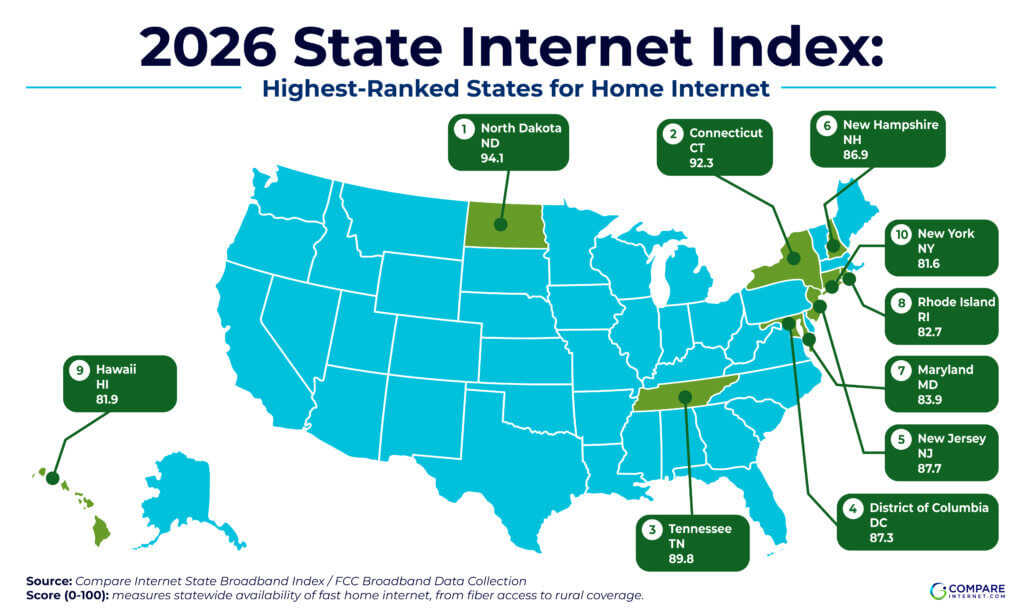
North Dakota tops the list for a reason most people wouldn’t expect: it’s not a dense, urban state; it’s a largely rural one that simply built consistent infrastructure everywhere. 99.2% of North Dakota homes have high-speed access, and the gap between its cities and its countryside is just 1 percentage point, the smallest in the country alongside Connecticut (0.2 points).
Connecticut, Tennessee, Washington D.C., and New Jersey round out the top five, all states where high-speed access exceeds 97% and the urban-rural gap stays in the single digits. Rhode Island deserves a special mention here too: despite being the smallest state by land area, it has the highest fiber access of any state in the nation at 83.2%.
What these states have in common isn’t wealth or population density. It’s consistency. They didn’t just wire their cities; they wired everywhere.
The worst states for home internet – America’s Internet Deserts
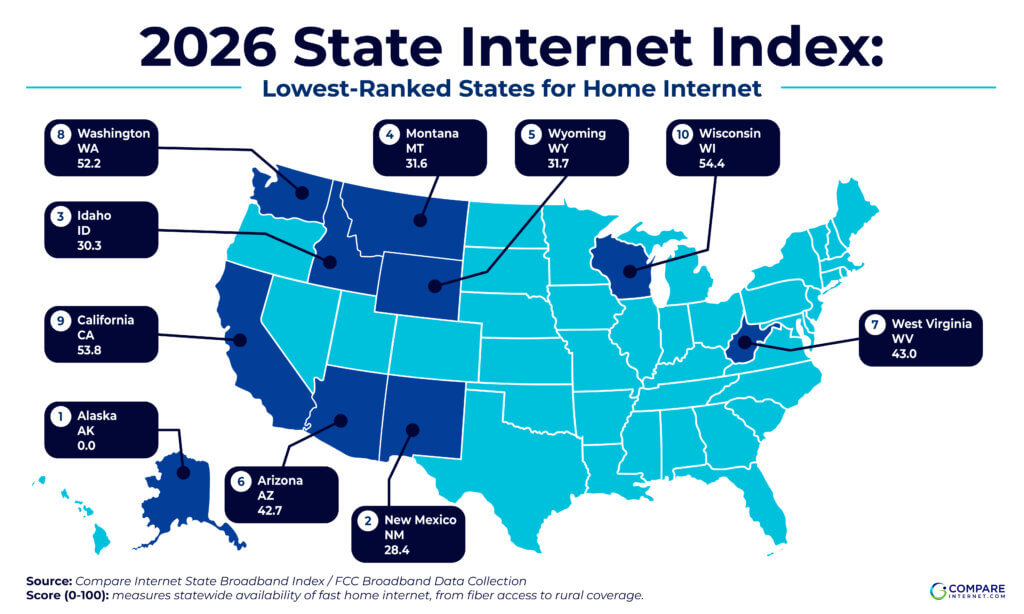
At the bottom of the list, Alaska stands alone. It’s the only state in the country that ranks last on every metric we measured: just 71.5% high-speed access, 14.2% fiber access, 12.5% gigabit access, and a 60-point gap between its cities and everywhere else. New Mexico, Idaho, Montana, and Wyoming join it in the bottom five, all states where vast rural geography has outpaced infrastructure buildout.
But the real surprise in the bottom 10 isn’t a rural state at all. It’s California (44th) and Washington (45th), two states that are home to some of the largest technology companies in the world. In both states, city coverage tops 96%, but rural coverage drops to roughly 52-57%. Even their cities lean more on legacy cable than fiber: urban California gets 93.9% of homes on cable, but only 41.8% on fiber, and urban Washington shows almost the same split (96.6% cable vs. 41.2% fiber). Tech-industry reputation, it turns out, doesn’t automatically translate to strong statewide home broadband infrastructure.
Wisconsin (43rd) and West Virginia round out a bottom 10 defined less by “no internet at all" and more by “internet that stops at the city limits."
Why the Urban-Rural Divide Is the Real Story
Looking only at a state’s overall average hides where the real gaps are. Idaho, New Mexico, Wyoming, Colorado, and California all show gaps above 44 percentage points between their cities and their rural areas, meaning a resident’s odds of getting high-speed service still depend heavily on which side of the county line they live on:
- Idaho: 53.9-point gap
- New Mexico: 48.8-point gap
- Wyoming: 47.5-point gap
- Colorado: 45.1-point gap
- California: 44.3-point gap
Fiber tells a similar story nationally. It’s the technology most providers and policymakers point to as the future of home internet. However, it still reaches barely more than half of U.S. homes (55.8%), while legacy cable networks continue to carry most high-speed connections, including in states most people would assume are already “fully wired."
That’s also why this Index measures wired infrastructure (fiber, cable, DSL) rather than the FCC’s broader “any technology" coverage figures, which fold in satellite service. Under an any-technology view, nearly every state shows 99%+ availability, a number driven largely by satellite providers claiming to reach almost anywhere. That flattens out the real differences between states, which is exactly what this Index is built to surface.
“The index demonstrates that a state’s geographic size or strong statewide averages do not guarantee uniform infrastructure,” said Caroline Lefelhoc, Content Editor at Compare Internet. “We deliberately focused on wired infrastructure because satellite coverage often obscures localized service gaps. Ultimately, the study shows that when vast geography meets limited physical networks, broadband deserts are inevitable, regardless of how the metrics are weighted.”
Finding the Right Internet for Where You Live
The gap between a state’s average and a specific address is exactly why “is broadband available in my state" is the wrong question. The right one is “what’s actually available at my address." That’s true whether you’re in a top-ranked state like North Dakota or a bottom-ranked one like Alaska: coverage varies block by block, not just state by state.
Enter your zip code to see every internet provider, plan, and speed available where you live, not just the statewide average.
Methodology
The Internet Score (0–100) is built entirely from FCC Broadband Data Collection data, weighting four measures of residential wired broadband: High-Speed Access at 100/20 Mbps (35%), Fiber Access (25%), Gigabit Access at 1000/100 Mbps (20%), and Urban–Rural Equity, the gap between a state’s urban and rural high-speed access rates (20%). Each metric is normalized against all 52 jurisdictions before weighting, so no single state’s raw numbers can distort the scale. We stress-tested this weighting under four alternative schemes (equal weighting, equity-heavy, speed-only, fiber-heavy); in every version, the top 5 and bottom 5 states remained essentially the same, with rank correlations between 0.89 and 1.00 against the primary methodology. The ranking measures where providers report residential service is offered, not adoption rates, subscription levels, or real-world speed test results.
Full dataset and state-by-state scores: State Internet Index Data