









 Call
Call 


 Access Your Account
 Which U.S. Wireless Carrier Is Most Prepared for a Major Disaster? We Ranked the Big Three

Table of Contents
Verizon leads by just 0.2 points as U.S. carriers turn to satellites, portable networks, and flying cell towers to keep people connected after disasters.
Rescue crews in Colombia are still searching collapsed buildings after a magnitude 7.4 earthquake that has killed at least 200 people, with the toll still climbing as search operations continue in hard-hit areas like Cali and Pereira; exact figures are moving by the hour, so treat any specific number as a snapshot rather than a final count. It’s the country’s most powerful quake in decades, and it has raised an urgent question for Americans living in disaster-prone parts of the U.S. too: what happens to your connection when the infrastructure carrying it fails?
The connectivity failures weren’t hypothetical. Claro and Tigo, Colombia’s two largest carriers, both confirmed network disruptions within hours of the quake. Tigo pointed to power outages and equipment damage, while Claro cited a surge in call and data traffic as people rushed to reach family at once. That combination (physical damage, power loss, and a demand spike) is exactly the scenario our Index is built to evaluate: which providers say they’re equipped to keep a network standing, or get it back up fast, when all three hit at once.
We built the 2026 Emergency Connectivity Readiness Index to answer that question for U.S. providers. Rather than ranking providers on everyday speed, price, or coverage claims, the Index scores their publicly documented ability to restore or replace connectivity after conventional infrastructure fails, from flying cell towers and portable networks to direct-to-phone satellite service and emergency power.
Here’s how each provider stacks up.
Key Takeaways
- Verizon ranks #1 in the Index, though only by a hair. Its composite score of 83.3 edges out AT&T/FirstNet’s 83.1 by just 0.2 points.
- Verizon leads on deployable scale. The carrier says nearly 3,000 mobile assets are ready for disaster deployment, including temporary cell sites, command centers and drone-response equipment, plus roughly 2,600 satellite-connected assets, a figure that includes some fixed-site links, not only field-deployable units.
- AT&T leads on dedicated public-safety infrastructure. FirstNet maintains more than 190 portable assets reserved exclusively for public safety, with access to 750+ additional AT&T deployables, backed by the only DHS-certified nationwide disaster-response program in the industry.
- AT&T can also put temporary cell sites into the air. FirstNet’s fleet includes three Flying COW drone-based cell sites built to provide temporary connectivity when ground infrastructure is unavailable or inaccessible.
- T-Mobile leads the Big Three on direct-to-device satellite resilience. During Winter Storm Fern, T-Satellite supported more than 250,000 users and carried more than 1.5 million messages when terrestrial networks were unavailable.
- Starlink represents a different form of resilience among the providers reviewed for context. Its Emergency backup service is built to bypass much of the local terrestrial network entirely, though the user terminal and router still require power.
- No provider wins every category. The evidence suggests disaster resilience increasingly depends on redundancy, portable infrastructure, backup power, terrestrial networks, aerial cells and satellite connectivity working together, and nearly every figure above is the carrier’s own disclosure rather than an independent measurement.
National Wireless Carrier Emergency Readiness
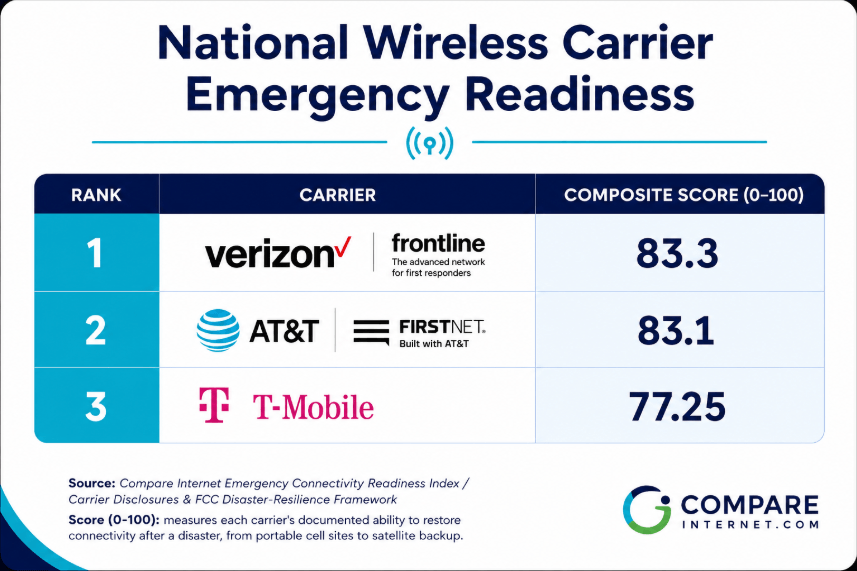
Verizon takes the top spot in the Index, though by a razor-thin 0.2-point margin over AT&T/FirstNet, a gap too small to read as a meaningful difference in real-world disaster readiness. T-Mobile trails on the composite score but leads the Big Three outright in the category that matters most to an individual phone: satellite independence.
See the full category-by-category scoring breakdown behind these numbers
AT&T / FirstNet: The only DHS-certified nationwide disaster program
AT&T’s edge in the Index has less to do with fleet size than with certification and exclusivity. AT&T was the first company in the country to receive a nationwide disaster-response certification from the Department of Homeland Security, under the agency’s PS-Prep program, administered through FEMA. That program, AT&T Network Disaster Recovery (NDR), has run for more than 30 years and represents over $1 billion in investment. It includes more than 320 self-contained equipment trailers and support vehicles, a team of more than 400 trained recovery personnel, and access to more than 5,400 portable generators and fuel trailers.
Layered on top of NDR is FirstNet, the nationwide public-safety network built with AT&T. As of Q2 2026, FirstNet maintains a dedicated fleet of more than 190 deployable assets, including SatCOLTs, Compact Rapid Deployables, and three drone-based “Flying COW" (Cell on Wings) units, reserved exclusively for public safety and available at no extra charge. FirstNet can also draw on more than 750 additional AT&T commercial deployables when needed. The network now covers roughly 3 million square miles, supports 31,900+ subscribed public-safety agencies, and logged 8.4 million-plus connections and 1,330-plus deployed solutions so far in 2026.
AT&T has put this technology to the test in real emergencies. Its Drones and Robotics team deployed Flying COWs during the January 2025 Los Angeles wildfires, including in Malibu’s Zuma Beach area and the Palisades-Brentwood neighborhood. They connected roughly 90 users at a time at average download speeds of 170 Mbps, putting temporary cellular coverage into the air over terrain where ground access was blocked.
Index verdict: AT&T scores 83.1 out of 100, a close second to Verizon, on the strength of DHS certification, a public-safety-exclusive network layer, and a long, well-documented track record in real disasters. Its differentiator is the most developed dedicated public-safety disaster-connectivity architecture in the analysis, not raw scale.
Verizon / Verizon Frontline: The largest deployable fleet, and it’s growing fast
Verizon Frontline is the closest challenger, and by one measure, it’s now the leader. Ahead of the 2026 hurricane season, Verizon expanded its total mobile deployable fleet to roughly 3,000 assets, including mobile cell sites, emergency command centers, and drone-mission capability. About 2,600 of those are satellite-connected, up sharply from the roughly 600 figure Verizon cited as recently as October 2024.
The fleet includes named equipment such as SPOT trailers (satellite-backed cell sites for areas where towers are down), THOR (a Tactical Humanitarian Operations Response Vehicle that generates 4G/5G and Wi-Fi and runs tethered-drone operations), and RRCU, a smaller-footprint version of SPOT. It also includes a new Multi-Orbit Off-Road Trailer that can switch between geosynchronous and low-Earth-orbit satellites, plus “digital twin" damage-assessment technology that compares pre- and post-storm drone imagery to pinpoint exactly which antennas, cables, or equipment were damaged.
Verizon backs the hardware with dedicated teams: the Frontline Crisis Response Team, a Major Event Response Incident Team equipped with gas-detecting drones, a Dedicated Impact Response Team, and the newly launched V Team Disaster Response Corps, which trains employee volunteers alongside the American Red Cross. In 2024 alone, Verizon’s Crisis Response Team deployed nearly 900 times, responding to more than 1,500 requests and supporting more than 800 public-safety agencies in almost every state.
Index verdict: Verizon scores 83.3 out of 100, narrowly the highest of the three on paper. Its most defensible differentiator is the largest publicly documented disaster-deployment fleet among the nationwide U.S. carriers reviewed.
T-Mobile: Leading the Big Three on direct-to-device satellite resilience
T-Mobile is taking a genuinely different approach here. It still runs a conventional disaster fleet: SatCOLTs, SatCOWs, COWs, hybrid portable generators rated for 50% longer uptime, and a new generation of drones built for real-time situational awareness. But its standout capability is T-Satellite, the Starlink-powered service that lets compatible phones connect directly to satellites when there’s no working cell tower nearby.
T-Mobile’s strongest evidence is real-world usage data. During Winter Storm Fern in January 2026, more than 250,000 users sent more than 1.5 million messages through T-Satellite when conventional terrestrial connectivity was unavailable, while T-Mobile’s self-organizing network kept affected sites running for a combined 250,000-plus extra minutes by automatically conserving power. T-Satellite also powers a satellite-based Text-to-911 feature. Notably, T-Mobile has made that specific 911 feature free to use on any compatible phone regardless of carrier, so even an off-grid Verizon or AT&T customer can reach emergency services through it. T-Mobile has since begun extending satellite roaming, starting with Canada and New Zealand.
Index verdict: T-Mobile scores 77.25 out of 100, third overall on the composite. It doesn’t lead the Index outright, but it has the strongest documented direct-to-device satellite story of the three carriers reviewed, which matters most for the average person whose phone, not a carrier’s truck, is the thing that needs to reconnect.
Alternative Connectivity & Backup Systems
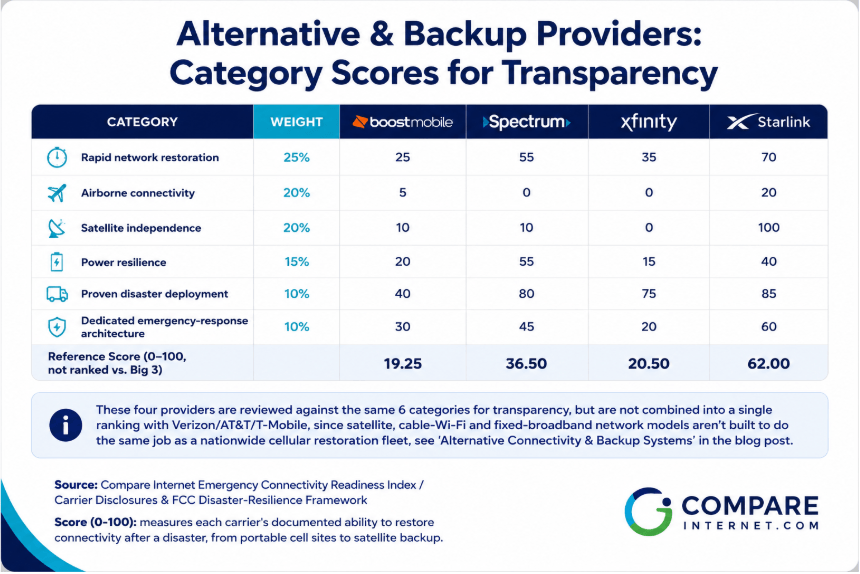
Starlink, Spectrum, Xfinity and Boost Mobile don’t operate the same kind of nationwide, facilities-based cellular network as Verizon, AT&T and T-Mobile, so we didn’t force them into the ranking above. Scoring Starlink on “airborne connectivity" or Spectrum on “Cell on Wheels" fleet size would penalize them for capabilities their networks were never designed to provide. Instead, here’s where each stands as a backup or complementary option:
Starlink, best independent satellite backup. Because it doesn’t depend on a functioning local terrestrial network, Starlink markets a dedicated Emergency Backup service for outages and disasters, and SpaceX maintains a standing policy of extending free service and donating hardware to vetted responders in declared disaster areas. Its one real constraint: the dish, router, and connected devices still need electricity to run.
Spectrum, strong fixed-broadband failover and community Wi-Fi response. Its new Invincible WiFi service, launched in February 2026, combines a Wi-Fi 7 router with automatic 5G cellular failover and up to eight hours of battery backup for home connectivity during outages. On the community side, Spectrum’s WiFi Community Response Trailers have been deployed repeatedly during real disasters, including more than 180 free public Wi-Fi access points and two mobile trailers deployed to Hunt and Ingram, Texas, after the 2025 Hill Country floods, and roughly 175,000 out-of-home access points unlocked across Florida, Georgia and South Carolina during Hurricane Ian.
Xfinity has a large public Wi-Fi activation strategy during disasters. Comcast routinely opens its Xfinity Wi-Fi hotspots to the public, customers and non-customers alike, ahead of and during major hurricanes. It opened more than 261,000 hotspots across Florida ahead of Hurricane Milton and more than 234,000 ahead of Hurricane Florence.
Boost Mobile has limited publicly documented dedicated disaster-restoration infrastructure compared with the Big Three. Boost runs its own cloud-native Open RAN 5G network, covering roughly 80% of the U.S. population, and maintains a disaster-preparedness program built around banks of temporary phones distributed at emergency shelters through a partnership with the Information Technology Disaster Resource Center (ITDRC). One additional wrinkle: EchoStar closed its roughly $23 billion spectrum sale to AT&T at the end of July 2026, and Boost’s cloud-based 5G core is expected to increasingly connect through AT&T’s network as that integration proceeds, meaning “independent" may describe Boost’s brand more than its future infrastructure.
What independent network testing adds to the picture
Everything above is carrier-disclosed. Two independent firms that measure network performance directly offer a useful outside check, though they measure everyday reliability, not disaster-specific restoration capability, so it’s a related but different question. RootMetrics, which conducts its own drive testing, put Verizon and AT&T in a virtual tie for the first half of 2026 overall performance and reliability, Verizon at 98.4 and AT&T at 98.3 out of 100, with T-Mobile close behind at 97.3. Opensignal, which measures crowdsourced data from millions of phones, found the opposite in its July 2026 report: T-Mobile led reliability and swept most award categories, with AT&T and Verizon each still leading a couple of specific metrics (AT&T on time-on-network, Verizon on video experience). That split shows how much a “best network" answer depends on methodology, the same caution we’d apply to our own Index, though RootMetrics’ near-tied AT&T-Verizon reliability scores do line up with our own finding that the two are close to even on disaster-response capability specifically.
Why power, and certification, matter as much as the tower
The final hop to a phone may be wireless, but the network behind it is not independent of physical infrastructure. Every cell site still needs electricity and a working backhaul connection to the wider network, and the FCC has repeatedly identified power outages as a leading cause of communications failures after disasters. The agency’s disaster-resilience framework specifically calls out backup power, mutual aid, and emergency roaming as core measures of network resilience. That’s why this Index weights power resilience alongside physical restoration capability rather than treating it as an afterthought.
It’s also why government certification carries real weight in this comparison. A press release describing a new drone or trailer is evidence of capability. A Department of Homeland Security certification, a documented real-world deployment, or a fleet used nearly 900 times in a single year is evidence that the capability actually works under pressure. That distinction, between announced, operational, and disaster-proven capability, is what separates this Index from a simple features checklist.
“A flying cell tower or a satellite-connected phone sounds like science fiction until the ground network goes down,” said Caroline Lefelhoc, Content Editor at CompareInternet. “What stood out in the data is that the carriers are solving the same problem in very different ways. Verizon has built enormous deployable capacity. AT&T has a highly developed public-safety and disaster-response system through FirstNet and Network Disaster Recovery. T-Mobile is pushing further toward connecting ordinary phones directly through satellites. There isn’t one technology that makes a network disaster-proof. The strongest resilience comes from having multiple ways to reconnect when the primary infrastructure fails.”
Methodology
The Emergency Connectivity Readiness Index scores Verizon, AT&T, and T-Mobile, the three nationwide, facilities-based wireless carriers whose network models are directly comparable, across six weighted categories built entirely from publicly documented, carrier-disclosed, and government-sourced evidence:
- Rapid network restoration (25%). Portable cell sites, COWs/COLTs, rapidly deployable equipment, mobile command centers, and total publicly documented deployable fleet size.
- Airborne connectivity (20%). Drone-mounted or tethered aerial cell sites, and whether the capability has been operationally deployed rather than only demonstrated.
- Satellite independence (20%). Satellite backhaul, satellite-connected portable cells, and direct-to-device satellite service that lets users connect without a functioning nearby tower.
- Power resilience (15%). Portable generators, battery systems, hybrid power equipment, and independently powered deployable gear.
- Proven disaster deployment (10%). Evidence is scored on a tiered scale, from announced or demonstrated capability up through disaster-proven, extensively operational capability, with real-world emergency use weighted well above capability that exists only in a press release.
- Dedicated emergency-response architecture (10%). Whether a provider maintains dedicated disaster infrastructure, personnel, and government certification (e.g., FirstNet’s public-safety-exclusive network, Verizon Frontline’s Crisis Response Team) rather than relying solely on its normal commercial network.
Starlink, Spectrum, Xfinity, and Boost Mobile were reviewed against the same six categories for evidence purposes, but are presented separately in “Alternative Connectivity & Backup Systems" above rather than folded into the Big Three ranking. Their network models (a non-terrestrial satellite constellation, fixed broadband with community Wi-Fi, a cable-based Wi-Fi network, and a newer facilities-based 5G buildout, respectively) aren’t built to do the same job as a nationwide cellular restoration fleet, and scoring them on categories like airborne connectivity would penalize them for capabilities they were never designed to offer.
Full category-by-category scoring, every source cited and the underlying evidence for each score: 2026 Emergency Connectivity Readiness Index: Data & Sources
The Index measures one narrow question: how many ways does each provider have to restore connectivity after infrastructure fails? It doesn’t prove any one carrier is “safest," and it doesn’t measure everyday reliability or coverage.
The broader takeaway: no single network will be indestructible. Resilience comes from redundancy, temporary cell sites, backup power, satellite backhaul, and airborne cells working together. The more useful question isn’t which carrier has the strongest signal today, but how many ways it has to reconnect you once that signal goes down.