










 Call
Call 

 Access Your Account
 The FCC Broadband Nutrition Label, Explained — Plus the 2025 Rollback Explained

Table of Contents
Every internet plan sold in the United States now requires a standardized disclosure (the FCC broadband nutrition label) that spells out the real price, speeds, data limits, and fees before you sign up. If you’ve seen one, but weren’t sure what half the fields meant, this guide breaks each section down to provide clarity.
There’s also a significant wrinkle: in October 2025, the FCC voted to propose stripping six of the label’s requirements. That proceeding is still pending, which means the rules you see today may look different by late 2026.
[search_block]
What Is the FCC Broadband Nutrition Label, and Why Does It Exist?
The FCC broadband label is a standardized disclosure modeled after the FDA nutrition facts panel on food packaging. The goal is the same, though. Instead of decoding marketing language, consumers get a consistent format to compare internet plans side by side.
Congress directed the FCC to create the labels as part of the 2021 Infrastructure Investment and Jobs Act [1]. The FCC adopted the broadband label rules in November 2022. Large internet providers (those with more than 100,000 subscribers) were required to display labels starting April 10, 2024. All internet providers, including smaller ISPs, were required to comply as of October 10, 2024 [2].
Compliance, however, hasn’t been exactly smooth. A study by York University researchers Jonathan A. Obar and Boxi Chen found internet service providers averaging just 5.2 out of 10 stars for compliance with FCC broadband label requirements, with most carriers ignoring standardized formatting despite agency-provided templates [3].
How to Read a Broadband Label: Field by Field
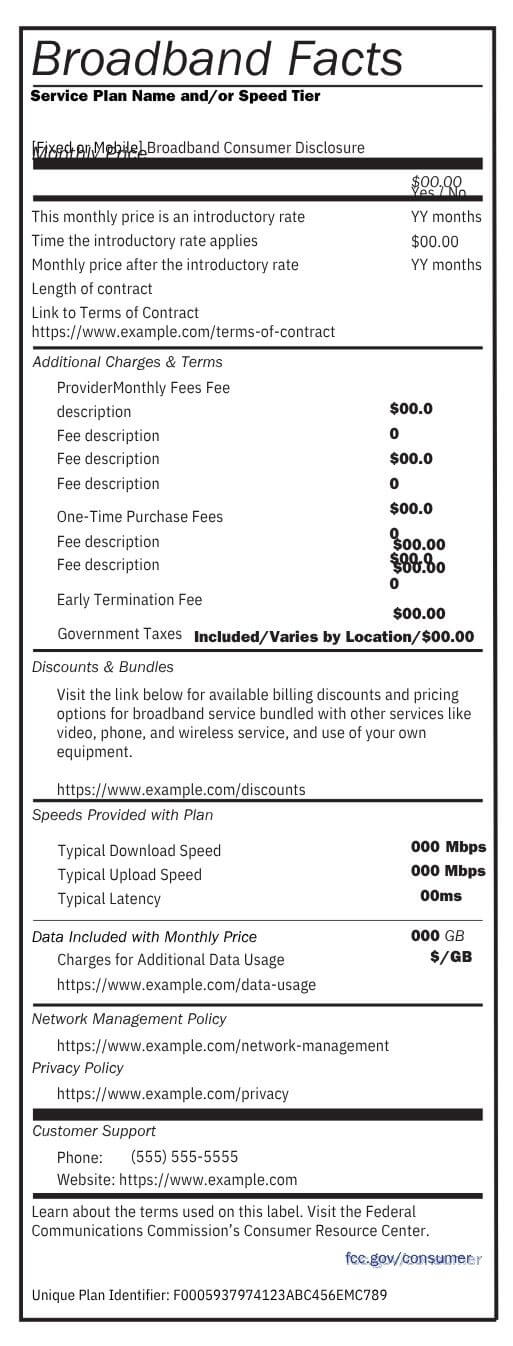
The broadband consumer label explained below covers every required disclosure section, including what it means, what to look for, and what to watch out for.
What Does the Monthly Price Field Tell You?
This is the plan’s advertised monthly rate. Under current rules, the label must show both the promotional price and the standard rate that follows. If a plan advertises $49.99/month but increases to $79.99 after 12 months, both figures must appear.
The post-promotional rate is the number that actually determines long-term cost. A $20–$40 gap between promo and standard rates is fairly common. A label that only shows the promotional price is not compliant with 2024 rules.
What Do “Additional Charges and Terms" Mean?
This section itemizes one-time fees (installation, activation) and recurring monthly equipment rental charges. Equipment rental fees typically run $10–$15 per month. That’s $120–$180 per year that won’t appear in a headline price. A label showing a $0 equipment fee means either hardware is included or you’re expected to supply your own modem and router.
What Is the Difference Between Typical vs. Maximum Internet Speed?
This is the most important field for most consumers, and the one most commonly misrepresented in provider marketing. The typical vs. maximum internet speed distinction separates real-world performance from best-case advertising.
The label must show typical download speed, typical upload speed, and typical latency during peak usage hours (generally 7–11 p.m.). “Typical" speed, as defined by the FCC, is what you can expect to receive at least 80% of the time. “Maximum" is the advertised ceiling most customers never consistently reach. A provider advertising “up to 1 Gbps" might show a typical speed of 300 Mbps once network congestion is factored in.
Upload speeds also appear here. On most cable plans, upload is dramatically lower than download (often 35–50 Mbps up versus 1,000 Mbps down), and the label makes that asymmetry explicit.
What Are the Data Cap and Network Management Fields?
The data cap field shows your monthly data allowance and whether overages trigger extra charges or speed throttling. Plans marketed as “unlimited" that slow speeds after an unstated threshold are required to disclose that practice here.
The network management section is where internet providers are supposed to disclose traffic management practices such as throttling, blocking, or paid prioritization. Most providers include general boilerplate language about “reasonable network management." Look for whether any specific services or traffic types are called out explicitly.

How to Find a Broadband Label
You can locate any broadband label two ways:
- At the ISP’s website: Under current rules, the label must appear at the point of sale, which is typically the plan selection or checkout page, without requiring extra clicks.
- FCC broadband label database: The FCC maintains a publicly searchable database where you can look up any provider’s label for any plan without visiting the provider’s site [4].
When comparing labels, the four fields that give the most accurate picture are: the post-promotional monthly price, typical (not maximum) download and upload speeds, equipment fees, and data cap. Those figures will tell you more about actual internet prices and long-term costs than any headline number in an ad.
The Broadband Label Rollback 2025: What the FCC Proposed to Eliminate
Here’s where internet plan transparency gets a bit complicated.
On October 28, 2025, the FCC voted 2-to-1 to issue a Second Further Notice of Proposed Rulemaking, proposing to roll back transparency measures designed to keep consumers informed [5]. Commissioner Anna Gomez called it “one of the most anti-consumer proposals" of her tenure: “The broadband label is about empowering consumers. This proposal says you don’t need that clarity." Chairman Brendan Carr and Commissioner Olivia Trusty voted in favor, while Commissioner Gomez dissented.
The six requirements proposed for elimination are:
- The requirement that labels be available in machine-readable (CSV) format
- The two-year archiving requirement for discontinued plans
- The requirement to display state and local taxes and fees on the label
- Physical label copies in retail stores
- Point-of-sale display requirements (ISPs had lobbied to replace visible labels with a clickable link)
- Certain standardized formatting requirements
Public Knowledge warned the changes could “create a permission structure for ISPs to continue to act without accountability" [6]. The Benton Institute for Broadband & Society notes the FCC will likely adopt new broadband label rules in the second half of 2026. No final rule has been issued as of publication. You can track the proceeding at FCC Docket No. 22-2.
The machine-readable CSV requirement is the most consequential for consumers who use comparison tools. The FCC created it to help third parties make it more easily collect and aggregate data for comparison-shopping tools. Eliminating it would make automated plan comparisons harder and reduce the data available to independent resources like CompareInternet when you compare internet providers.

Finding the Best Internet in Your Area
The FCC broadband label database gives you the raw information, but you still need to know which providers serve your address. The best internet in your area depends on which ISPs actually operate at your location, and that varies block by block.
Use the label fields to run a real internet comparison. Post-promotional price, typical speeds, equipment fees, and data caps will give you a far more accurate picture than headline advertised rates.
Enter your ZIP code to compare internet plans side by side and find the best internet providers available where you live.
[search_block]
Frequently Asked Questions
Is the FCC broadband nutrition label required for all internet providers?
Yes. As of October 10, 2024, every ISP in the United States — regardless of size — is required to display a standardized broadband label at the point of sale for each plan it offers. This applies to both home internet and mobile broadband plans.
Where can I find a broadband label for my current or prospective internet plan?
Check the ISP’s website at the plan selection or checkout page — the label should be visible without extra clicks. You can also search directly at broadbandlabels.fcc.gov, the FCC’s official database, which lets you look up labels by provider or address.
What is the difference between typical and maximum internet speed on the label?
Maximum speed is the best-case ceiling a provider uses in marketing. Typical speed is what the FCC defines as the speed you can expect to receive at least 80% of the time during peak hours. The typical figure is far more useful when evaluating real-world performance.
Will the 2025 broadband label rollback change what I see today?
Not immediately. The October 2025 vote was a proposal — a notice of proposed rulemaking — not a final rule. The public comment period closed in early 2026, and the FCC is expected to issue a final rule in the second half of 2026. Until that rule is adopted and takes effect, current label requirements remain in place.
Sources
[1] Congress.gov. “Infrastructure Investment and Jobs Act (H.R. 3684)."
[2] Fierce Network. “FCC sets deadline for broadband label compliance."
[3] Broadband Breakfast. “Study Reveals Patchy ISP Compliance With FCC Broadband Label Requirements."
[4] Federal Communications Commission. “Broadband Consumer Labels."
[5] Broadband Breakfast. “FCC Moves to Scale Back Broadband Label Requirements."
[6] Light Reading. “Broadband labels back on FCC’s to-do list."