










 Call
Call 


 Access Your Account
 Dual-Band vs. Tri-Band WiFi: Which Router Do You Need?

Table of Contents
If you’ve been shopping for a new router, you’ve almost certainly come across dual-band and tri-band—and wondered whether the price difference is worth it. For most households, a dual-band router is all you need. But if your home is packed with devices or you’re building a mesh network, tri-band can make a real difference.
[search_block]

What Are WiFi Bands?
Think of WiFi bands like lanes on a highway. Each band is a separate radio frequency your router uses to send and receive data. More lanes mean more traffic can flow without congestion, but not every household needs a six-lane freeway.
The two foundational frequencies are 2.4GHz and 5GHz. The 2.4GHz band has a longer range and passes more easily through walls, but it’s slower and more prone to interference from things like microwaves, baby monitors, and your neighbors’ routers. The 5GHz band is faster and less congested, but its signal doesn’t travel as far.
Understanding the 2.4GHz vs. 5GHz WiFi trade-off can help you choose the right router, because the dual band vs. tri band router decision is really just about how many of these lanes you get.
What Is Dual-Band WiFi?
A dual-band router broadcasts on two frequencies simultaneously: one 2.4GHz band and one 5GHz band. That’s it. Your devices connect to whichever band suits them best. Older smart home gadgets and far-away devices tend to use 2.4GHz, while your laptop streaming a 4K show or your gaming console will gravitate toward 5GHz. Dual-band routers have been the standard for home use since the early 2010s and remain the most widely available and affordable option. Entry-level models start around $40–$80 [1]. For smaller homes with 10 to 15 devices, a well-placed dual-band router running WiFi 6 is genuinely all you need.
What Is Tri-Band WiFi?
A tri-band router adds a third radio band to the mix. In the most common configuration (found in WiFi 6 routers), that means one 2.4GHz band and two 5GHz bands. The extra 5GHz band effectively doubles the high-speed “lanes" available for your devices, reducing congestion when many devices compete for bandwidth at once.
Newer WiFi 6E tri-band routers swap the second 5GHz band for a 6GHz band [2]. Introduced with WiFi 6E in 2021 and expanded by WiFi 7 in 2024 [3], the 6GHz band offers far more bandwidth with virtually no interference. The Wi-Fi Alliance notes it adds up to 1,200MHz of new spectrum, compared to just 70MHz on 2.4GHz [4].
The catch is that your devices must support WiFi 6E or WiFi 7 to use the 6GHz band. Most phones and laptops from 2022 onward qualify, but older devices will simply use the 5GHz band instead.
Dual-Band vs. Tri-Band WiFi: Key Differences
| Dual-Band | Tri-Band (WiFi 6) | Tri-Band (WiFi 6E) | |
| Bands | 2.4GHz + 5GHz | 2.4GHz + 5GHz + 5GHz | 2.4GHz + 5GHz + 6GHz |
| Best for | Small homes, light users | Busy households, 20+ devices | Power users, newest devices |
| Typical price | $40–$150 | $150–$300 | $200–$500+ |
| Mesh backhaul | Shared with devices | Dedicated band available | Dedicated band available |
| Device compatibility | Universal | Universal | Requires WiFi 6E/7 for 6GHz |
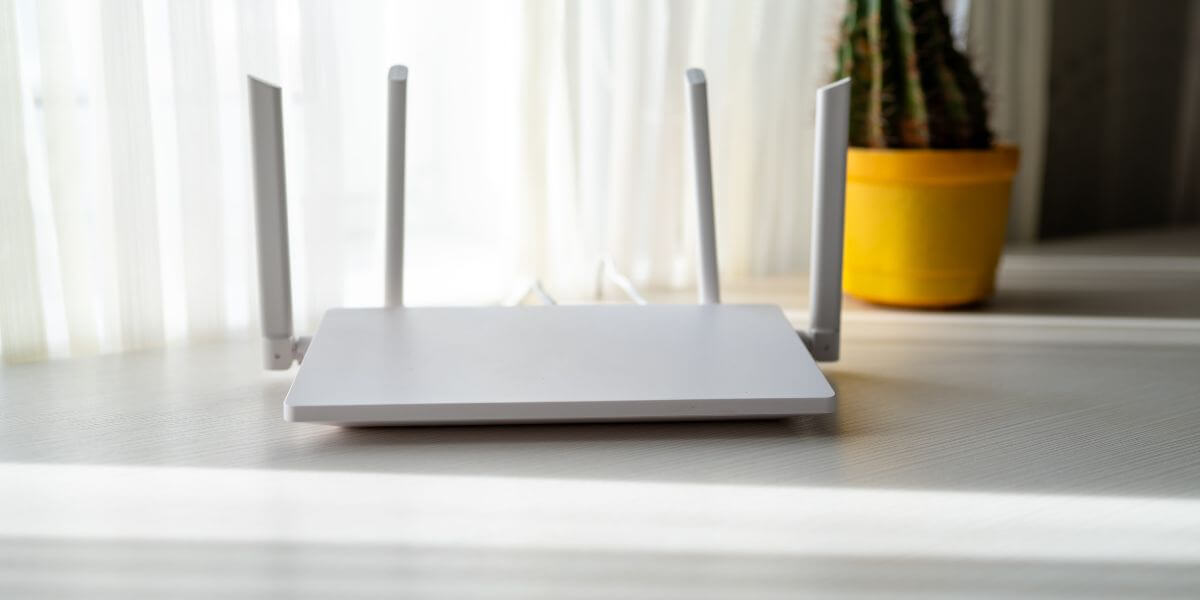
The tri-band vs. dual-band WiFi difference comes down to capacity, not raw speed. A tri-band router won’t make your Netflix stream faster if you’re the only one watching, but it will keep everything running smoothly when 30 devices are connected at once.
Should I Get a Tri-Band Router?
This is the question most people are really asking, and the honest answer is that it depends on your device count and home size.
Choose dual-band if:
- Your household has fewer than 15 connected devices
- You live in an apartment or smaller home (under ~1,500 sq. ft.)
- You’re not running a mesh WiFi system
- Your budget is under $150
Consider tri-band if:
- You have 20 or more connected devices (phones, TVs, tablets, smart speakers, security cameras, gaming consoles, etc.)
- Multiple people in your home simultaneously stream, game, or video call
- You’re setting up a mesh network (more on this below)
- You have newer devices that support WiFi 6E or WiFi 7
It’s worth noting that tri-band routers typically cost $100–$200 more than comparable dual-band models. If your internet plan is under 500 Mbps and you have fewer than 15 devices, that premium is unlikely to produce noticeable improvement. The money is often better spent upgrading your internet plan instead.
Mesh Networks and Tri-Band: A Perfect Match
If there’s one use case where tri-band truly earns its price tag, it’s mesh WiFi networks.
A mesh system uses multiple router nodes placed around your home to blanket every room in coverage. The nodes need to communicate with each other constantly (passing your traffic back to the main router) and that “backhaul" communication eats into your available bandwidth.
With a dual-band mesh system, your devices and the nodes share the same bands, losing a meaningful chunk of bandwidth to behind-the-scenes node communication.
A tri-band mesh network solves this by dedicating one band (typically the second 5GHz or the 6GHz band in WiFi 6E systems) exclusively to node-to-node traffic. Your devices get the other bands all to themselves. Popular systems like the Eero Pro 6E, Google Nest WiFi Pro, and NETGEAR Orbi all use this dedicated backhaul approach, delivering noticeably more consistent speeds throughout large homes.
If you’re shopping for a whole-home mesh system, tri-band is almost always worth the upgrade.

WiFi 6 and 6E: How Router Bands Have Evolved
Router technology has evolved quickly. Single-band routers (2.4GHz only) were the norm through the mid-2000s [5]. Dual-band went mainstream around 2010 with WiFi 4 (802.11n). Tri-band arrived around 2015 as WiFi 5 pushed speeds higher and device counts grew.
The pivotal standard was WiFi 6 (802.11ax), finalized in 2019, which dramatically improved how routers handle many simultaneous connections—critical as the average U.S. household now has more than 20 connected devices, according to Deloitte’s Digital Media Trends report [6]. WiFi 6E followed in 2021, opening the 6GHz band. WiFi 7 (802.11be) reached consumers in 2024 with even higher throughput.
For most buyers today, a WiFi 6 router (dual-band or tri-band) hits the sweet spot of performance and value. WiFi 6E is worth the premium if your devices support it and you want to future-proof your setup.
How to Choose the Best WiFi Router Bands for Your Home
Before buying, ask yourself three questions:
- How many devices do you have? Count everything: phones, laptops, TVs, smart speakers, security cameras, thermostats. Under 15? Dual-band is fine. Over 20? Consider tri-band.
- How large is your space? Homes over 2,000 sq. ft. often benefit from a mesh system, which shifts the calculation toward tri-band.
- What does your internet plan support? Even the best tri-band router can’t deliver speeds your internet provider doesn’t provide.
Before upgrading your router, make sure your internet connection can keep up. It’s worth comparing internet providers in your area. A faster plan and a modest router will often outperform a premium router on a slow connection.
[search_block]
FAQs
Is tri-band WiFi faster than dual-band?
Not for a single device. Tri-band routers don’t speed up individual connections — they increase capacity, so more devices can operate at full speed simultaneously. If you’re the only person on the network, you likely won’t notice a difference. The benefits emerge when your network is heavily loaded.
Can older devices use a tri-band router?
Yes. All your existing devices will connect to a tri-band router via the 2.4GHz or 5GHz bands, just as they would with a dual-band router. The third band simply provides extra capacity. The only exception is the 6GHz band, which requires a WiFi 6E or WiFi 7 device.
What’s the difference between WiFi 6 router bands and WiFi 6E router bands?
WiFi 6 routers operate on 2.4GHz and 5GHz. WiFi 6E adds the 6GHz band, offering significantly more bandwidth with far less congestion. WiFi 6E tri-band routers are ideal for heavy users and mesh systems, but only devices that support WiFi 6E can access the 6GHz band.
Do I need a tri-band router for gaming?
For a single gaming setup, a dual-band router with a strong 5GHz connection is typically sufficient. Tri-band helps when multiple people are simultaneously streaming or gaming and you’re experiencing lag — the extra band prevents your gaming traffic from competing with everything else on the network.
Sources
[1] Amazon. “Dual Band Routers.”
[2] Netgear. “Tri Band & Quad Band Routers.”
[3] Astound. “Why WiFi 7 is a game‑changer.”
[4] Intel. “2.4 GHz vs. 5 GHz vs. 6 GHz: What’s the Difference?”
[5] Beaming. “A history of WiFi speed and range.”
[6] Deloitte. “Digital Media Trends report.”