









 Call
Call 

 Access Your Account
 What Is Fiber Internet?

Table of Contents
If you’ve been shopping for a new internet provider lately, you’ve probably noticed that fiber internet keeps coming up as the gold standard. Providers advertise it heavily, comparison sites rank it at the top, and people who have it tend to talk about it like it changed their lives. But what actually makes fiber different from the cable or DSL connection most people grew up with? And is it worth the switch?
Here’s a straightforward breakdown of what fiber internet is, how it works, and why it’s become the most sought-after type of home internet service available today.
The Basic Idea: Light Instead of Electricity
Most traditional internet connections, whether cable or DSL, transmit data as electrical signals through copper wiring. That technology has been around for decades and works reasonably well, but it has limits. Copper degrades over distance; it can pick up interference, and there’s a ceiling to how much data it can carry at once.
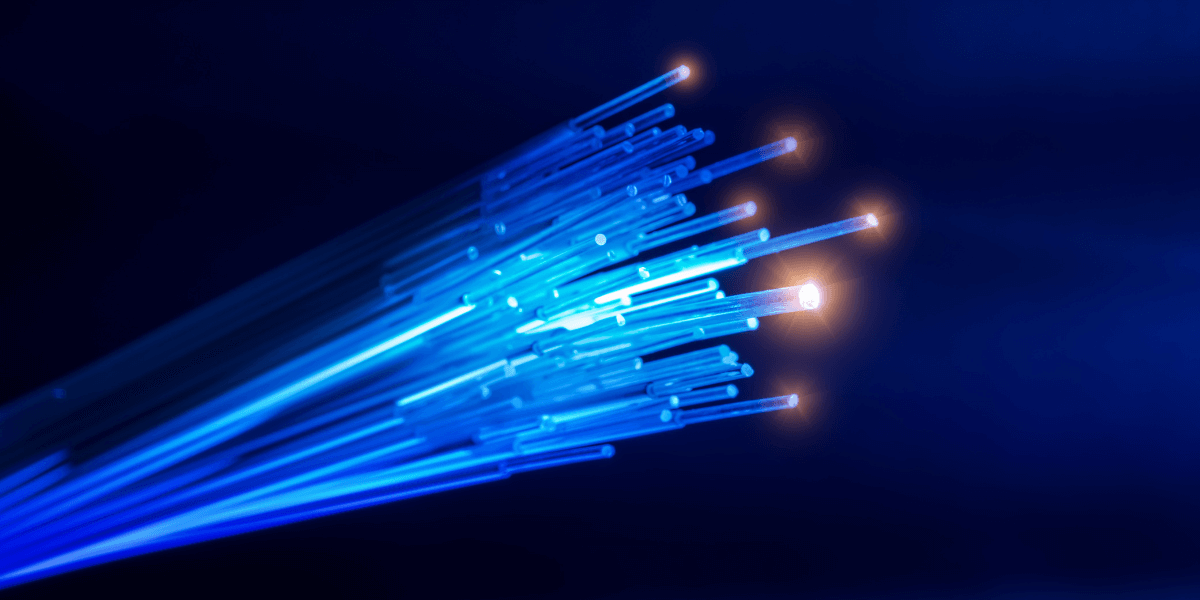
Fiber internet works on an entirely different principle. Instead of electricity moving through metal, fiber uses pulses of light traveling through thin strands of glass or plastic. Because light moves faster and can carry far more information than an electrical signal through copper, fiber connections can deliver speeds and reliability that copper-based networks simply can’t match.
The cables themselves are about as thick as a human hair, bundled together and protected by an outer jacket. They’re immune to electromagnetic interference, unaffected by weather in the way copper can be, and capable of transmitting data over much longer distances without signal loss.
Symmetrical Speeds
The Detail That Actually Matters
One of the most important features of fiber internet is something that doesn’t always get the attention it deserves: symmetrical upload and download speeds.
With cable internet, download speeds and upload speeds are very different. A plan might advertise 300 Mbps download but only offer 20 or 30 Mbps upload. That setup made sense when most people were primarily consuming content, downloading files, and loading web pages. But the way people use the internet has shifted.
Remote work means video calls, which are two-way. Cloud storage means regularly uploading files, photos, and backups. Content creation, whether that’s video, audio, or anything else, requires fast uploads. With fiber, a 500 Mbps plan typically means 500 Mbps in both directions, and that balance makes a real practical difference in day-to-day use.
How Fast Is Fiber Internet, Really?
Fiber plans typically start around 300 Mbps and go up from there, with gigabit plans (1,000 Mbps) being one of the most commonly available tiers. Some providers now offer multi-gig options pushing 2,000 Mbps or even higher for households with serious bandwidth demands.
To put that in perspective, the FCC defines broadband as 100 Mbps download and 20 Mbps upload as a minimum threshold. A standard gigabit fiber plan delivers ten times that download speed and fifty times that upload speed. Even the entry-level fiber plans from most major providers are fast enough to support an entire household of simultaneous users without anyone noticing slowdowns.
For a closer look at which fiber internet plans are available in your area and how they compare on speed and price, CompareInternet.com’s fiber internet page is a useful starting point.
Reliability Is Where Fiber Really Pulls Ahead
Speed gets most of the attention, but reliability might be the more compelling argument for fiber. Copper-based connections are susceptible to a number of issues that simply don’t affect fiber in the same way.
Electrical interference from appliances, power lines, and other devices can affect copper signal quality. Moisture and corrosion degrade copper wiring over time. And because cable internet is a shared medium, speeds can dip noticeably during peak usage hours when everyone in your neighborhood is online at the same time.
Fiber doesn’t share those vulnerabilities. The light signals aren’t affected by interference, the glass or plastic strands don’t corrode, and modern fiber networks are designed to handle high traffic without the same kind of congestion issues. The result is a connection that tends to be more consistent throughout the day rather than fast in the morning and sluggish in the evening.

Find your fiber internet provider
Is Fiber Available Where You Live?
This is the practical question that determines everything else. Fiber internet requires physical infrastructure, and while it’s expanded significantly over the past decade, it isn’t available everywhere yet. Dense urban and suburban areas tend to have strong fiber coverage, while rural areas often have fewer options.
The fastest way to find out what’s available at your specific address is to use a provider comparison tool. CompareInternet.com lets you search by location to see exactly which providers offer fiber service where you live, along with current pricing and plan details. That kind of side-by-side view saves a lot of time compared to visiting each provider’s website individually.
What About the Cost?
Fiber internet has a reputation for being expensive, and historically, that was true. The infrastructure required to build out a fiber network is significant, and early fiber plans carried a premium price to match. Pricing has come down considerably as competition has increased and build-out has expanded.
Today, fiber plans are often priced comparably to cable plans, especially when you factor in that most fiber providers include equipment at no extra monthly charge. Some cable providers charge $10 to $15 per month just to rent a modem and router, which adds up to $120 to $180 per year on top of the service cost. With fiber, that’s typically not part of the equation.
Promotional pricing, AutoPay discounts, and bundle options can bring fiber costs down further, so it’s worth looking at the full picture rather than just the advertised rate.
Fiber Internet Plans for You
Fiber internet is fast, reliable, and increasingly affordable. The technology behind it is fundamentally different from older copper-based connections, and those differences show up in real ways during everyday use, particularly for households where multiple people are working, streaming, gaming, or video calling at the same time.
You can find out if CenturyLink Fiber internet is available near you by calling 1-833-836-0417 to speak with an agent. If you want to compare internet providers available at your address, CompareInternet.com’s fiber internet resource is a quick way to find out what’s available and compare your options in one place.