











 Call
Call 


 Access Your Account
 A Brief History of Fiber Internet
Table of Contents
Imagine settling in for a movie night in the early 2000s. You’ve rented a DVD, popped some popcorn, and gathered the family. Fast forward to today, where you’re streaming 4K content while one family member video chats with relatives overseas, another plays an online game, and a third downloads a massive work file—all simultaneously, without a hint of buffering. This transformation in how we experience and consume digital content is largely thanks to fiber internet, the invisible superhighway running beneath our streets and homes.
In many homes, high-speed internet has become as essential as electricity or running water. Among the various internet connection types available, fiber internet stands out as the fastest and most reliable option, capable of transmitting data at literally the speed of light. But what is fiber internet? And how did this revolutionary technology come to be? As it turns out, the journey from theoretical concept to the lightning-fast fiber connections we enjoy today spans over a century of innovation, scientific breakthroughs, and technological evolution that has fundamentally changed how we connect to the world.
The Origins of Fiber Optic Technology
The story of fiber internet begins in the mid-1800s, long before the internet itself was conceived. The fundamental principle behind fiber optics—using light to transmit information—was demonstrated as early as the 1840s when scientists like Jean-Daniel Colladon and Jacques Babinet showed that light could be guided through water jets [1].
Back in 1854, British physicist John Tyndall showed that light could travel through a curved stream of water, proving that light can follow a specific path. This principle would become the foundation of fiber optic technology. By the 1880s, Alexander Graham Bell, the inventor of the telephone, was already experimenting with his “Photophone," a device that transmitted sound via light beams.
However, the practical application of these concepts was still decades away. The challenge was finding a suitable medium to transmit light efficiently over long distances without significant signal degradation.
Early Development of Fiber Optics (1950s-1960s)
The modern era of fiber optics began in the 1950s when researchers started experimenting with glass fibers. In 1954, Narinder Kapany and Harold Hopkins made significant strides when they successfully created bundles of fiber for transmitting images, earning Kapany the title “Father of Fiber Optics" [3].
In 1961, Elias Snitzer and Will Hicks from American Optical made a breakthrough by successfully transmitting a laser beam through a thin glass fiber. While it was an impressive achievement, these early fibers had high signal loss, which made them impractical for long-distance communication.
The true game-changer came in 1966 when Charles Kao, working at Standard Telecommunications Laboratories in England, revealed how to make low-loss fiber suitable for telecommunications. Kao proposed that by removing impurities from glass and creating an optical cladding over a pure glass core, it would be possible to transmit light signals over long distances with minimal degradation. For this groundbreaking work, Kao would later be awarded the Nobel Prize in Physics in 2009 [4].
Making Fiber Optic Communication Practical (1970s)
Moving forward with fiber
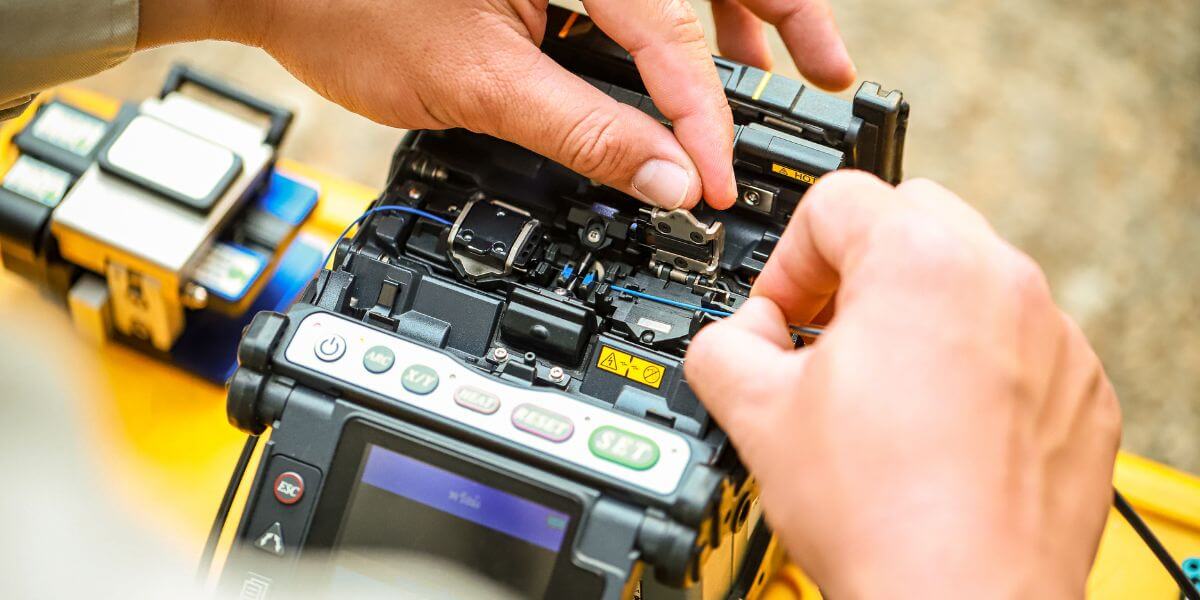
The 1970s saw the transformation of fiber optics from laboratory curiosity to commercial reality. In 1970, researchers at Bell Labs and the Ioffe Physical Institute in Leningrad independently developed semiconductor lasers that could operate continuously at room temperature, providing a reliable light source for fiber optic systems.
In 1972, Corning Glass Works (now Corning Inc. [5]) researchers Donald Keck, Peter Schultz, and Robert Maurer developed the first low-loss optical fiber using a vapor deposition process to create ultra-pure glass. This manufacturing breakthrough reduced signal loss dramatically, making long-distance optical communication feasible.
The first real-world applications soon followed. In 1975, the North American Aerospace Defense Command (NORAD) became an early adopter of fiber optic technology, using it to link computers at their Cheyenne Mountain headquarters in Colorado [6]. The superior security and immunity to electromagnetic interference made fiber optics ideal for military applications.
From Experiments to Infrastructure (Late 1970s-1980s)
The telecommunications industry began serious field trials of fiber optic technology in 1977. In April of that year, AT&T installed the first telecom fiber optic link in the underground tunnels beneath Chicago [7]. Just weeks later, GTE successfully transmitted live telephone calls through fiber in Long Beach, California, while the British Post Office tested their own link at Martlesham Heath in the UK.
These successful trials led to rapid adoption. Between 1980 and 1984, AT&T established its first large fiber optic backbones along the East and West Coasts of the United States, operating at 45 Mbps using 850 nm lasers in multimode fiber. These early networks marked the beginning of fiber’s dominance over traditional copper wiring and even communications satellites for long-distance telecommunications.
A major milestone came in 1988 when AT&T laid TAT-8, the first transatlantic fiber optic cable. This groundbreaking submarine cable could carry 40,000 telephone calls simultaneously and remained in service for 13 years, demonstrating the durability and capacity of fiber optic infrastructure.
The Internet Age and Fiber Evolution (1990s)
As the 1990s dawned, two revolutionary developments would converge: the growing fiber optic infrastructure and the nascent internet. In 1990, Tim Berners-Lee at CERN developed the foundations of the World Wide Web, including HTML, HTTP, and URLs. When the internet became publicly accessible around 1994, the existing fiber backbone provided the necessary infrastructure for this new digital frontier.
The 1990s also saw significant technological advances that increased fiber’s capacity. The introduction of Erbium-Doped Fiber Amplifiers (EDFAs) [8] in 1995 allowed optical signals to be regenerated without converting them back to electrical signals, greatly extending fiber’s reach. This innovation also facilitated the implementation of Wavelength Division Multiplexing (WDM), which enabled multiple data streams to be transmitted simultaneously over a single fiber by using different wavelengths of light.
The “dot-com bubble" of the late 1990s, while economically problematic, spurred massive investment in fiber optic infrastructure. When the bubble burst in 2001, it left behind an extensive network of “dark fiber" (unused fiber optic cable) that would later support the internet’s continued growth.
The Birth of Fiber to the Home (FTTH)
Getting fiber into homes
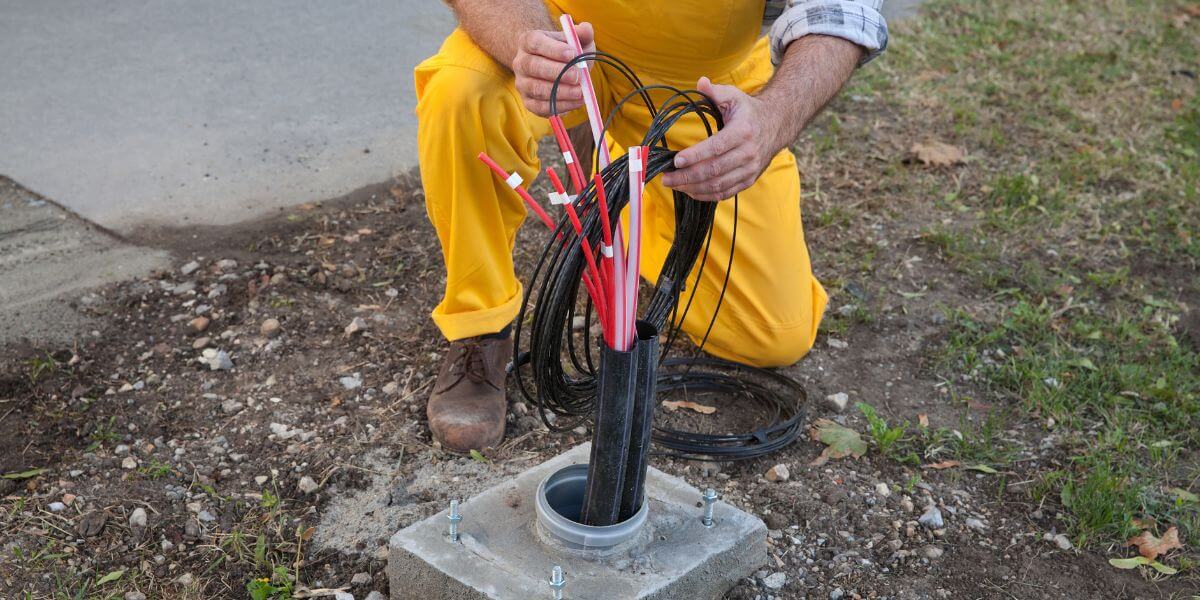
While fiber had become the standard for long-haul telecommunications, most consumers still connected to the internet through copper telephone lines (DSL) or coaxial cable. This changed with the development of Passive Optical Networks (PONs), which made it economically feasible to extend fiber connections directly to homes and businesses.
Early FTTH trials began in Japan and France in 1978, but high costs limited widespread adoption. The first standardized PON technology, 10base-FP ethernet, was approved as IEEE 802.3J in 1993. This was followed by newer standards like BPON (Broadband PON) in 2005 and GPON (Gigabit PON) in 2008.
In 2005, Verizon launched its FiOS service, beginning with the first installation in Keller, Texas. This marked the first large-scale FTTH deployment in the United States. Other major initiatives followed, including Google Fiber, which launched in Kansas City in 2012, offering unprecedented 1 Gbps connections to residential customers—largely what we consider to be today’s fiber internet definition.
Modern Fiber Internet and Future Developments
Fiber and its future
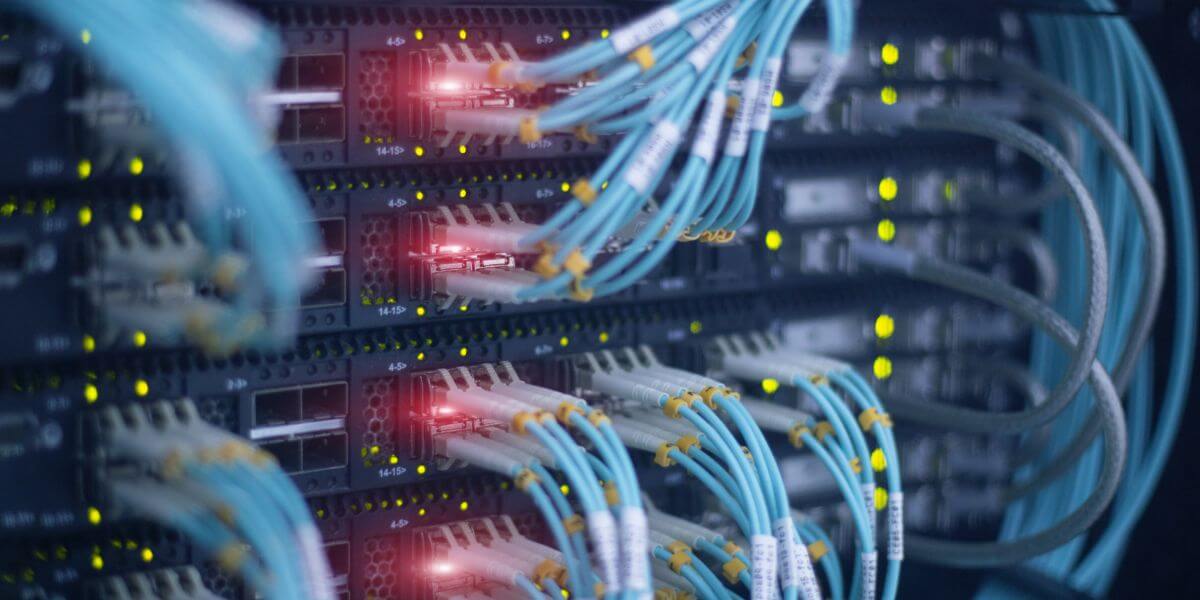
Today’s fiber internet offers speeds that were unimaginable just a decade ago. Modern fiber connections commonly deliver 1 Gbps (1,000 Mbps) for residential users, with 10 Gbps becoming increasingly available. For context, the first commercial fiber optic links of the 1970s operated at just 45 Mbps—modern connections are over 200 times faster.
Fiber’s advantages over traditional copper-based internet connections include:
- Significantly higher bandwidth capacity
- Lower latency (delay in data transmission)
- Greater reliability and resistance to environmental factors
- Immunity to electromagnetic interference
- Longer lifespan and lower maintenance requirements
The COVID-19 pandemic in 2020 demonstrated fiber’s resilience when millions of people suddenly shifted to working and learning from home. Despite the enormous increase in internet traffic, fiber networks continued to deliver reliable service, confirming fiber’s status as critical infrastructure. Recent innovations continue to push the boundaries of what’s possible with fiber optics:
- In 2016, Nokia Bell Labs demonstrated transmission speeds of 1 terabit per second over standard single-mode fiber
- Hollow-core fibers, which became commercially available in 2021, allow light to travel almost 50% faster than through traditional glass cores
- High-count fiber optic cables introduced in 2018 can contain up to 6,912 individual fibers, supporting massive data centers and dense metropolitan areas
The future of fiber internet looks even more promising with the development of technologies like Space Division Multiplexing (SDM) and quantum key distribution for ultra-secure communications. As we move further into the digital age, fiber internet will continue to evolve, providing the foundation for technologies we have yet to imagine.
Metronet Fiber Internet: The Next Generation of Connectivity
Metronet is at the forefront of bringing cutting-edge fiber internet technology directly to homes and businesses. Unlike traditional internet service providers that rely on outdated copper infrastructure, Metronet builds dedicated fiber networks that deliver symmetrical upload and download speeds, ensuring you get the full performance you pay for.
With fiber’s virtually unlimited capacity for data transmission, Metronet’s network is future-proof—ready to handle tomorrow’s bandwidth demands without expensive upgrades. Whether you’re streaming 4K video, participating in video conferences, gaming online, or managing a smart home full of connected devices, Metronet fiber internet provides the speed, reliability, and low latency you need.
Sources
[1] Olson Technology. “A Brief History of Optical Fiber."
[2] Intraway. “The History of Fiber to the Home."
[3] Optica. “In Memoriam: Narinder S. Kapany, 1926-2020"
[4] The Nobel Prize. “Illustrated information."
[5] Corning. Corning Inc. Homepage.
[7] The Fiber Optic Association Inc. “FOA Fiber Optic Timeline."
[8] FiberLabs Inc. “Erbium-Doped Fiber Amplifier (EDFA)."